What Does a Eucalyptus Tree Look Like? A Complete Visual Guide
What does a eucalyptus tree look like? Eucalyptus trees often have tall, straight trunks with smooth bark that peels in strips or patches. Their leaves are usually long, narrow, and lance-shaped, with a bluish-green or silvery tint.
These trees vary a lot depending on the species. Some, like the Tasmanian blue gum, can grow more than 100 feet tall with conical crowns. Others stay bushy and short.
You’ll see bark colors change as the eucalyptus tree grows. It starts smooth and gray. Species like the rainbow eucalyptus turn colorful as they mature.
Look at the bark first. Then check the leaves. These tell you the tree’s age and type.
Watch the tree’s size and crown shape to spot the differences between species in your area. These clues make it easier to identify eucalyptus trees wherever you see them.
Key Takeaways
- Eucalyptus bark peels off in strips, revealing fresh, colorful layers.
- Leaves are lance-shaped, often bluish-green or silvery, and aromatic.
- Tall species like Tasmanian blue gum reach over 100 feet in height.
- Shorter types, called mallees, generally stay below 30 feet tall.
- Rainbow eucalyptus bark can show multiple colors like orange and green.
- Climate and soil affect bark color and leaf shape significantly.
What Are the Key Visual Features of a Eucalyptus Tree?

Eucalyptus leaves look different when the tree is young versus mature. Young trees have rounder, bluish-green leaves arranged opposite each other. As the tree grows, its leaves get long and narrow.
They become leathery and darker green. The leaves grow alternately along the stem.
The bark varies widely among eucalyptus species, but several types are common. Some trees have smooth bark that peels away in strips, revealing multicolored layers beneath. Some trees have bark that looks rough and fibrous.
It can appear shaggy or stringy. The color is often brownish-gray or reddish.
Mature eucalyptus trees usually have a straight, tall trunk with a rounded or slightly irregular canopy. The tree’s height often ranges from 50 to 150 feet. Some species, like blue gum, exceed 100 feet.
Height depends on the species. The tree’s width usually varies between 20 to 30 feet.
This gives it a slim and elegant shape. It fits well in large areas.
Leaf shape is one of the easiest features to spot. The long, ribbon-like leaves sway easily in the wind and often have a glossy texture. This leaf type helps the tree hold water better.
It also keeps the tree cooler on hot days. They are native to mild coastal climates.
Bark color appears as the trunk thickens, which takes time. In nurseries, this happens in about 2 to 3 years. The trunk must grow thicker first.
Trees like rainbow eucalyptus have smooth bark that peels off. The peeling reveals bright oranges, greens, and purples underneath. Colors change as layers peel away.
Trees with rough bark have less vivid colors but add texture. This texture makes the tree stand out in any garden. Rough bark gives more visual interest.
Eucalyptus trees show a tall shape and distinct leaf form. Their bark can be smooth or shaggy. These features help you identify the tree.
These traits matter because they affect how the tree fits your garden size and style. Mature trees have steady shapes and dark green leaves.
Their leaves contrast with the bark’s unique patterns. This gives them a nice look.
How Do Eucalyptus Leaves and Bark Change with Age and Species?
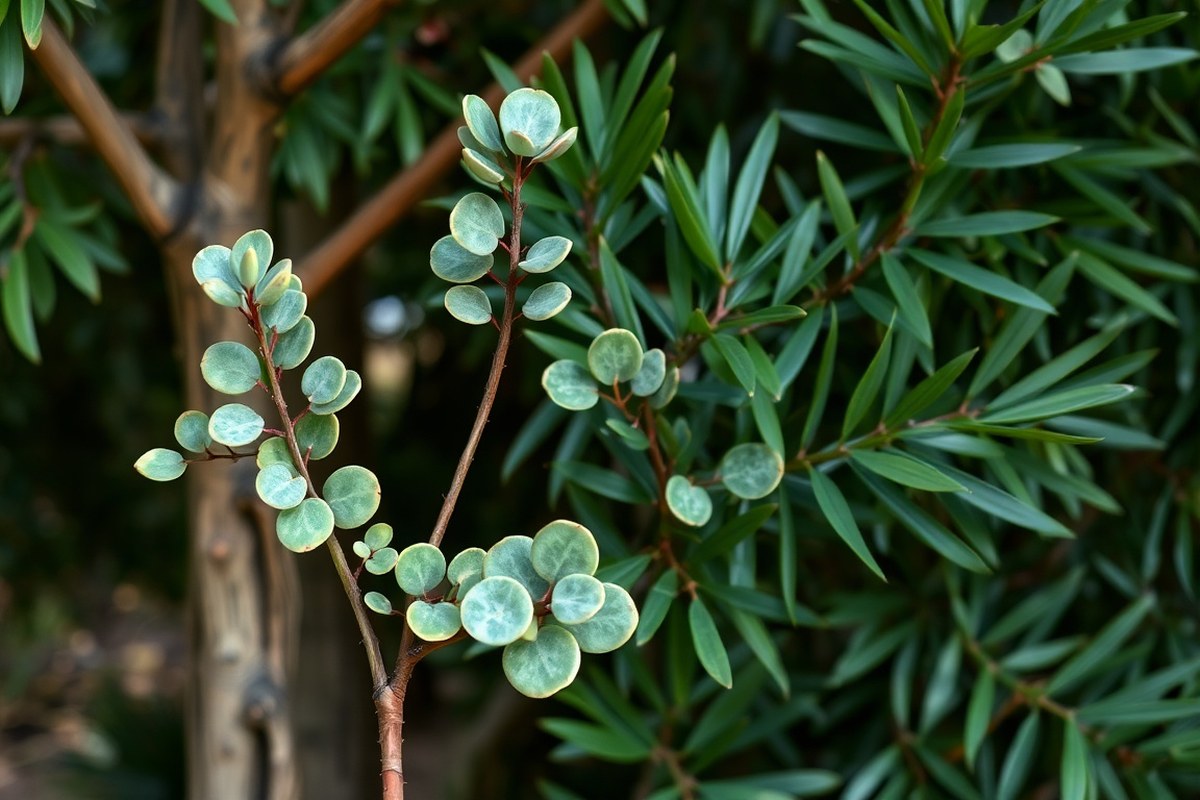
Juvenile eucalyptus leaves are often different from mature ones. They tend to be round, broad, and bluish-green, growing opposite each other on young branches. Adult leaves become narrow and lance-shaped.
They alternate along the stems. They feel greener and more leathery.
The leaf colors and shapes shift because eucalyptus trees show heteroblasty. For example, the silver dollar eucalyptus starts with round, silvery-blue leaves that become thinner and longer. Adult lemon eucalyptus leaves have a citrus scent.
They turn a solid green. They are firmer than juvenile leaves.
| Leaf Stage | Shape | Color | Arrangement |
|---|---|---|---|
| Juvenile | Round or broad | Bluish-green or silvery | Opposite pairs |
| Mature | Narrow, lance-shaped | Dark green | Alternating |
Bark appearance varies widely among species and changes with age. Young eucalyptus bark often peels away in strips or flakes, showing fresh layers beneath.
Rainbow eucalyptus bark shows colorful streaks of green, orange, and brown. These colors appear when the outer bark sheds.
As eucalyptus grows, bark texture may become rougher. Some species keep smooth bark their whole life. Some, like the silver princess gum, develop a furrowed bark pattern.
Others retain shiny, smooth bark. Bark color can start gray or white. It changes to reddish-brown or dark gray over years.
Watch for bark peeling seasons to catch the rainbow eucalyptus’s color changes at their peak.
Bark changes happen gradually over 3 to 10 years, with new bark layers visible after peeling. Monitoring these changes helps identify tree age and species.
Spinning gum trees have whitish-green striped bark. It stays smooth and rarely gets rough.
Leaf and bark traits link directly to the growth environment and species traits. Knowing these features helps gardeners choose eucalyptus trees for shade or decoration. Noticing bark and leaf shifts also guides on tree health and age.
Visual Differences Among Popular Eucalyptus Species
Different eucalyptus species have clear visual differences. Bark color, leaf shape, height, and growth form help tell them apart. Knowing these traits lets you identify species like rainbow eucalyptus, blue gum, and silver dollar easily.
Rainbow Eucalyptus Traits
Rainbow eucalyptus stands out with its multicolored bark. The bark peels in strips, showing green, blue, purple, orange, and maroon layers. This makes it one of the most visually striking eucalyptus species.
It grows fast and tall, often reaching 100 feet or more in tropical climates. The leaves are lance-shaped, glossy green, and larger than some other species. Rainbow eucalyptus doesn’t grow naturally in Australia but thrives in places like Hawaii and the Philippines.
Blue Gum Features
The blue gum eucalyptus, or Eucalyptus globulus, has smooth bark that sheds in long strips. Its bark color ranges from white to pale blue-gray. The tall tree can grow up to 164 feet in height.
It ranks among the tallest eucalyptus species. This happens in ideal growing conditions.
Leaves are narrow, lance-shaped, and hang downwards. They have a leathery texture with a blue-green shade. Blue gum’s bark and leaves look cool and uniform.
This is different from the rainbow eucalyptus. Its colors are calmer.
Silver Dollar and Other Common Species
Silver dollar eucalyptus leaves are almost round or circular. These differ from the lance-shaped leaves of blue gum. Rainbow eucalyptus leaves are similar to blue gum’s shape.
It features a broad, dense canopy with a single trunk. The tree grows between 30 and 65 feet tall.
It is smaller than both blue gum and rainbow gum. This size difference is noticeable.
Other species with rounded leaves include baby blue eucalyptus and round-leaved gum. Some species grow as shrubs or small trees, like snow gum and round-leaved snow gum. Silver dollar eucalyptus is popular for its foliage and often used in floral arrangements or containers.
Below is a table that shows key differences between these eucalyptus species for quick identification:
| Species | Bark Color | Leaf Shape | Typical Height (ft) | Growth Form |
|---|---|---|---|---|
| Rainbow Eucalyptus | Multicolored (green, blue, purple, orange) | Lance-shaped, glossy | Up to 100+ | Tall tree with peeling bark |
| Blue Gum | White to pale blue-gray | Narrow, lance-shaped | Up to 164 | Tall tree, smooth peeling bark |
| Silver Dollar Eucalyptus | Grayish, smooth | Rounded, nearly circular | 30-65 | Tree with broad, dense canopy |
| Baby Blue Eucalyptus | Smooth, silvery gray | Rounded | 16-30 | Shrub or small tree |
| Snow Gum | White to grayish | Lance-shaped | Small to medium tree | Tall shrub or small tree |
These visual differences matter when choosing eucalyptus for your garden or landscape. A rainbow eucalyptus needs space for its tall growth and vibrant bark display. Silver dollar eucalyptus suits smaller spaces or container growing due to its size and rounded leaves.
Visual cues like leaf shape and bark color can help you identify lesser-known eucalyptus species too. Shrubby forms will have compact height and dense leaf cover, unlike tall, spreading species. Notice these traits to save time.
They help you pick the right eucalyptus tree. This matches your needs better.
How Does the Size and Shape of Eucalyptus Trees Vary?
Eucalyptus trees range widely in size and shape, affecting how much space they need. Some species grow tall and straight, reaching over 200 feet like the rainbow eucalyptus. Others stay small, forming shrubby or mallee habits with multiple stems and dense foliage.
The fastest growers put on 6 to 10 feet each year in ideal climates. Rain, soil quality, and temperature shape their growth rate and form. For example, Eucalyptus globulus is called Southern blue gum.
It can grow 150 feet tall. It also has a broad canopy in good conditions. The Tasmanian white peppermint is Eucalyptus pulchella.
It usually stays under 50 feet tall. It looks like a smaller tree or a large shrub.
- Rainbow eucalyptus: 200+ feet tall, narrow canopy
- Southern blue gum (Eucalyptus globulus): up to 150 feet tall, 50 feet wide
- White peppermint (Eucalyptus pulchella): 30 to 50 feet tall, compact shape
- Moort (mallee form): 10 to 20 feet tall, multi-stemmed shrub
- Young trees up to 1.5 meters best for transplanting
Estimating space starts with knowing mature height and spread. Allow for about one-third more space than the expected width for healthy air flow.
Fast-growing types need more space as they can double canopy size in a few years. Smaller mallee or marlock types fit better in limited garden areas.
Growth shapes change with the environment. In dry or windy spots, eucalyptus trees often grow shorter and wider. In moist, sheltered areas, they may grow taller and straighter.
Consider your local climate when planning your eucalyptus tree. Check your soil type too. This helps predict the tree’s mature size and space needs.
What Do Eucalyptus Flowers and Seed Pods Look Like?
Eucalyptus flowers stand out with their unusual shapes and bright colors. They often appear in clusters and lack typical petals. Instead, silky stamens form the colorful part of the flower.
Colors commonly range from creamy white to yellow and red. Some species show pink or orange shades too. Each flower’s cap or operculum falls off as the blossoms open.
- Shape: round clusters or pom-pom like tufts
- Common colors: white, cream, yellow, red, pink, orange
- Size: flowers typically 0.4 to 2 inches wide
- Operculum: hard caps shed before flowering
- Flowering season varies: spring to summer, depending on species
- Some species, like the Rainbow eucalyptus, have smaller, less showy flowers
- Mallee eucalyptus species flower mostly in spring within multi-stemmed growth
Seed pods appear after flowers dry up and fall off. These woody capsules usually sit above the leaves. They look like small, round or cylindrical containers with several valves that open to release seeds.
Pod colors start green, gradually turning brown. When mature, they crack open, exposing tiny, winged seeds inside. The pods vary in size and shape by species.
Some pods are very small. Others grow almost the size of a walnut.
Watch for tight-bud flowers or unopened pods; it can indicate stress or unsuitable climate.
Different eucalyptus species show clear variations during flowering and pod development. For example, the Argyle apple tree produces large white flowers in summer.
The Snow Gum blooms smaller, cream flowers in colder climates. These distinct traits help with identification throughout the year.
Keep in mind it might take years before your eucalyptus shows flowers or pods. Some trees don’t produce mature blooms or pods until they are 5 to 10 years old.
Knowing what they look like helps you plan your garden. You can support wildlife like birds and bees better.
How to Recognize Eucalyptus Trees Indoors or in Containers?
Eucalyptus plants in containers look quite different from mature trees outdoors. Potted eucalyptus shows smaller, rounder leaves and thinner stems. Mature trees have larger, lance-shaped leaves and thick trunks that grow up to 20 meters.
Leaf Differences Indoors vs Outdoors
Indoor eucalyptus leaves tend to be smaller and more rounded compared to outdoor trees. Young potted plants often have egg-shaped or coin-like leaves. Outdoor mature trees have long, lance-shaped leaves with sharp edges.
The leaves can reach up to 6 inches (15 cm) in length. They stand out in the landscape for their size.
Leaves inside also look more delicate and may have a bluish-green tone on some species. In contrast, outdoor trees have glossy green leaves that shed gradually over the year.
The size and shape change as the eucalyptus matures. So leaf shape signals plant age and location.
Stem and Branch Structure
Container-grown eucalyptus has thinner, flexible stems with fewer branches. The stems appear green and leafy, with visible points where juvenile leaves attach. Some types, like spinning gum, show unique leaf growth.
The stem appears to grow through the center of bluish-green oval leaves. This feature makes them easy to spot.
Mature trees outdoors develop thick, woody trunks with rough bark. Branches spread wider and produce lance-shaped evergreen leaves. Regular pruning indoors encourages bushier growth mimicking a shrub rather than a tall, single trunk.
Growth Expectations in Containers
Potted eucalyptus plants can grow up to 8 feet (2 meters) in one season from seed. Growth slows as the container fills, limiting size naturally. You won’t get the full 12 to 20 meters height indoors.
Trees need to be planted outside to reach that size. Indoor space limits their growth.
Prune regularly to keep the plant bushy and healthy indoors. Avoid deep freezes and maintain temperatures above 50°F for best growth. Good drainage prevents root rot in containers and keeps leaves glossy.
Follow these steps to identify and care for potted eucalyptus compared to outdoor specimens:
- Check leaf shape and size: rounder and smaller indoors, lance-shaped and larger outdoors.
- Look at stem thickness: thin and flexible indoors, thick and woody outdoors.
- Observe overall height: up to 8 feet indoors, much taller outdoors.
- Assess leaf color: bluish-green or duller tones indoors, glossy green outside.
- Notice branching pattern: bushier and denser indoors, wider and spreading outdoors.
- Keep track of pruning: frequent trimming indoors keeps shape, less needed outdoors.
- Monitor temperature and moisture: warmer, stable indoors, variable and colder outside.
What Visual Signs Indicate a Healthy vs Unhealthy Eucalyptus Tree?
Leaves that turn yellow, wilt, or curl often mean stress. You can spot diseases by spotting spots, holes, or webbing on leaves. Bark should be firm but shedding bark in strips is normal for eucalyptus.
Look for dry, cracked, or darkened bark patches to spot a problem early. Branch dieback is a common sign of root or water issues. A healthy tree has strong, green leaves and firm bark that flakes naturally.
- Yellowing leaves usually show nutrient lack or too much sun.
- Dark or soft bark spots can hint at fungal infections.
- Wilting leaves or dropping branches may mean drought stress.
- Webbing or holes suggest insect pests like borers or caterpillars.
- Leaf discoloration with red margins may point to specific pest attacks.
- Pruned branches should heal cleanly, avoiding jagged cuts to prevent infection.
Distinguishing abiotic issues like drought from pests is key. Abiotic damage often affects many leaves evenly, while pests cause patchy or clustered damage. Check for pests before treating since the wrong treatment may worsen health.
Pruning shapes eucalyptus but improper cuts can hurt the tree. Remove dead or crossing branches in early spring for best healing. Avoid heavy pruning in late summer to prevent stress before winter.
How Does Climate and Growing Conditions Affect Eucalyptus Appearance?
Eucalyptus trees change how they look depending on their climate and soil. Hot or cold weather affects the bark and leaves differently. Water and soil type also change their shape and color.
Visual Adaptations to Climate
Drought causes eucalyptus leaves to shrink and turn grey-green. Trees slow their growth and grow smaller leaves to save water. Cold weather makes leaves thicker and sometimes darker to shield against frost.
Some eucalyptus species in dry areas shed older leaves to reduce water loss. They may also develop tougher bark to protect against heat and fire. In colder zones, trees grow more compact shapes to keep warmth.
Bark Color Variations by Environment
Sunlight and temperature change eucalyptus bark color. Hot, dry climates often bring lighter bark shades, like pale grey or white, which reflect heat. Cooler, wetter areas develop darker bark that retains warmth.
Shedding bark reveals fresh, colorful layers underneath. You might see orange, cream, or pink depending on the species and the environment. Bark gets rough or flaky in dry areas.
| Climate Zone | Bark Color | Leaf Size | Growth Rate (feet/year) | Growth Form |
|---|---|---|---|---|
| Hot & Dry | Pale grey, cream | Smaller, narrow | 1 to 2 | Compact, rough bark |
| Temperate | Orange, pink tones | Medium, elongated | 3 (rapid) | Medium size, smooth bark |
| Cool & Moist | Darker grey, brown | Larger, thicker | 2 to 3 | Tall, dense canopy |
These differences help you choose eucalyptus species for your garden. Select types suited for your local heat and water supply. That ensures healthy growth and desired appearance.
Leaf Shape and Size Changes by Growing Conditions
Soil quality affects eucalyptus leaf shape and size. Rich, well-drained soil encourages larger, broader leaves. Heavy or waterlogged soil leads to smaller and discoloured leaves.
Water availability also matters. Trees with steady water produce softer, greener leaves.
Those under drought stress grow tougher leaves that look dull or dusty. Leaf angles may change to reduce sun exposure and preserve moisture.
Tip: Mulch around the base to keep moisture and prevent soil from drying out too fast.
Step-by-Step Action Plan to Identify Eucalyptus Trees by Sight
Use this plan to spot eucalyptus trees and notice their key features. Each step helps you get better at identifying their size, leaves, bark, and flowers.
- Day 1: Look for the smooth bark with peeling strips. It should feel soft and often shows colors like white, cream, or green.
- Day 3: Check leaf shape and color. Young eucalyptus trees usually have round or oval leaves. Adults have long, narrow leaves.
- Week 1: Find any flowers or seed pods. Look for small clusters of white, cream, or yellow flowers. Check for woody seed pods shaped like cups near the flowers. These details help identify the eucalyptus tree.
- Week 2: Measure the tree’s height and observe the crown shape. Note if it is tall and narrow or more rounded and wide.
- Week 3: Spot signs of health. Healthy leaves look green and shiny. Avoid trees with lots of brown leaves or cracked bark.
- Month 1: Compare what you see with pictures of common eucalyptus species. Use leaf and bark differences to narrow your guess.
- After 6 weeks: Check the tree if it’s indoors or in a pot. Look for smaller leaves and tighter, more compact growth. These signs show how your tree is doing. This often shows a young or stressed eucalyptus.
- Ongoing: Note the climate and soil. Trees in dry, hot spots may have tougher bark and smaller leaves. Adjust your identification clues accordingly.
Frequently Asked Questions
Where Do Eucalyptus Trees Grow in the US?
Eucalyptus trees mainly grow in California and the southern states. They prefer mild, coastal climates and may struggle in cold winters without protection.
What Does a Fully Grown Eucalyptus Tree Look Like?
A full-grown eucalyptus tree can reach 12 to 20 meters tall. It has a straight trunk.
The canopy is bushy. Their bark varies from smooth to peeling, depending on species.
Is There a Difference Between an Eucalyptus Plant and an Eucalyptus Tree?
Yes, eucalyptus plants are younger or smaller forms, often shrubs or young trees. With time and space, they grow into large eucalyptus trees up to 100 meters tall.
What Are the Downsides of Having an Eucalyptus Tree?
Eucalyptus trees shed bark and leaves, which can be messy. They also use a lot of water and may not suit small yards or cold climates.
Can Eucalyptus Trees Grow Indoors?
Yes, smaller eucalyptus types can grow indoors in containers. They need bright light and regular pruning to keep size manageable.
How Fast Do Eucalyptus Trees Grow Each Year?
Eucalyptus trees grow fast, often 3 to 6 feet per year. Growth speed depends on species and climate conditions.
Final Thoughts
Knowing what a eucalyptus tree looks like makes choosing or caring for one easier. Focus on its bark, leaves, and size to spot it confidently. Start by examining any leafy trees nearby and check their bark and leaves closely today.