What Does a Holly Plant Look Like? A Complete Visual Guide to Identification
What does a holly plant look like? Holly plants show shiny, leathery green leaves all year long.
Their size varies from small shrubs to tall trees reaching 50 feet. You’ll spot sharp, spiny edges on many leaves, a key sign of holly.
These plants produce small white flowers in late spring. Bright red berries follow on female plants, appearing in late summer or fall. The berries add color and help identify the plant during colder seasons.
Holly stems grow slowly, often spreading 6 to 24 inches annually. Their leaves appear alternately on the stem, each 2 to 6 centimeters long. Look for this pattern when checking unknown evergreens in your garden.
Holly is versatile, working as hedges, specimens, or foundation plants. Knowing its leaf shape, berry color, and growth can reveal if yours is holly.
Key Takeaways
- Holly leaves are leathery, glossy, 2, 6 cm long, with sharp points.
- Female holly plants produce bright red berries about 5, 8 mm wide.
- Most holly plants grow between 2 and 6 meters tall in gardens.
- Holly leaves grow alternately along stems, not in pairs or clusters.
- White holly flowers bloom in late spring before berries develop.
- Growth rate is slow to medium, about 6 to 24 inches per year.
What Are the Key Visual Features of a Holly Plant?
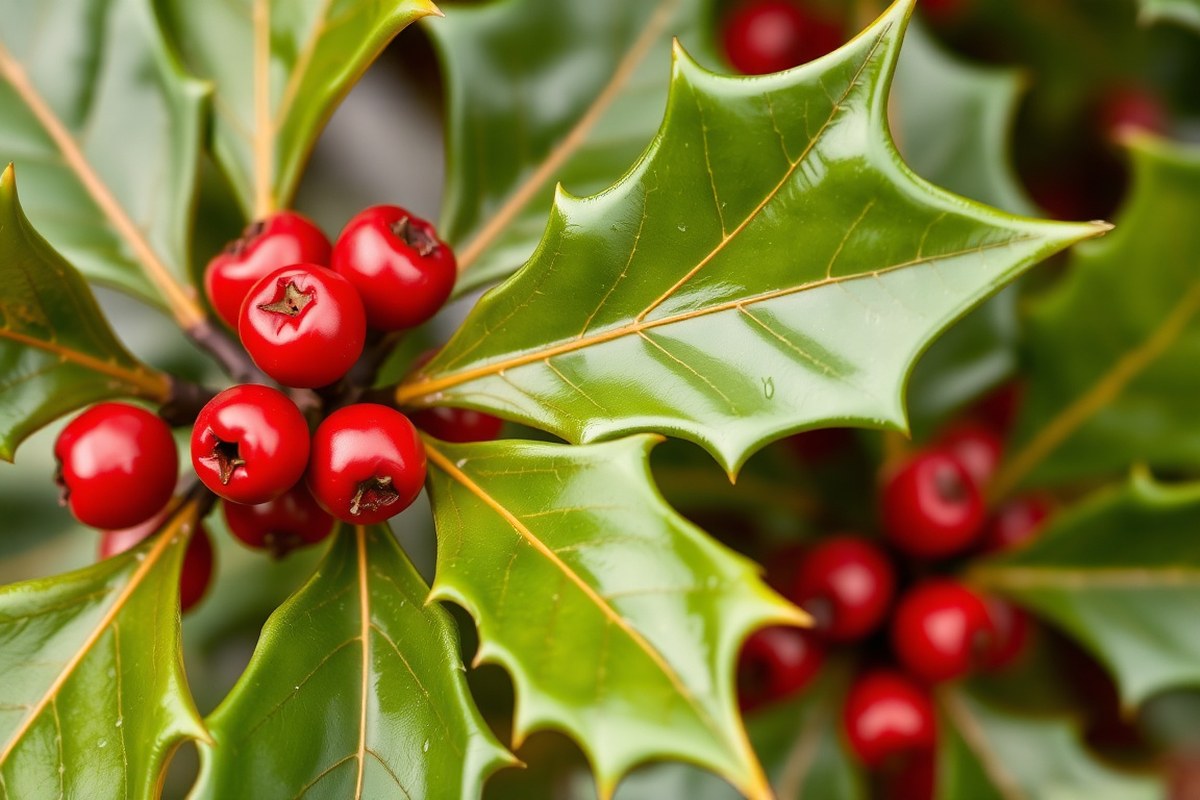
Holly plants generally show glossy, leathery leaves that feel firm and smooth. The leaves are dark green and usually measure 2 to 6 centimeters long. You’ll notice their sharp, spiny edges, which give hollies their classic look.
The stems of holly plants are woody and very sturdy. They hold leaf clusters along the branches.
Stems are typically brown and can be straight or slightly curved. This solid structure helps the plant support bright berries and withstand seasonal winds.
Holly berries come in small, round shapes, usually about 5 to 8 millimeters in diameter. The common bright red color on female plants stands out against the dark green leaves. Some varieties, like the winterberry, may have yellow or orange berries instead.
In size, holly plants vary a lot. Some garden hollies grow just 2 to 3 feet tall.
Wild American hollies can reach over 50 feet. Most home gardeners see medium shrubs about 5 to 10 feet tall, which suits yards well.
Look for a leaf texture that’s both smooth and tough, almost leathery to the touch. Unlike thin or soft leaves, holly leaves hold their shape year-round without wilting. This texture helps identify holly even without berries.
Holly has shiny, spiked leaves arranged one after another. Its stems are firm to the touch. Bright berry clusters appear if males pollinate females nearby.
Look at these traits carefully to confirm a true holly plant. This helps you avoid confusing it with other evergreens.
How Do Holly Leaves and Stems Vary Among Different Types?

Holly leaves and stems vary a lot depending on the species. Some hollies have spiny leaves like English and American types.
Others, such as Japanese and Yaupon hollies, feature smooth or finely toothed leaves. Stems also differ in texture and growth habits, which can help with identification.
Spiny English and American Holly Leaves
English holly and American holly have dark green leaves. The edges have sharp, stiff spines. These spines stick out along the leaf edges.
Their leaves feel leathery and glossy, with a rounded base and raised veins. These spines are a classic feature of holly leaves.
Some upper leaves have smoother edges. This difference is normal for these plants.
Leaf size usually ranges from 2 to 4 inches in length. Both species have alternate leaf arrangements. Leaves don’t sit opposite each other.
They grow spaced along the stem instead. Their growth rate is slow to medium, typically adding 6 to 24 inches per year.
Smooth or Toothed Japanese and Yaupon Holly Leaves
Japanese holly has much smaller leaves than English or American holly. Its leaves are box-shaped with fine teeth, not spines. They usually measure half an inch to one inch long.
They feel smooth compared to spiny leaves. Yaupon holly leaves are smooth-edged and glossy, with a dark green color and oval shape.
Both have alternate leaf arrangements too. This helps tell them apart from boxwood. Boxwood leaves sit opposite each other on the stem.
Japanese holly stays small and compact. Its leaf texture is even and smooth. This makes it good for hedges and bonsai.
Stem Texture and Growth Habit Differences
Stems on holly plants can be smooth or rough depending on species and age. Younger branches usually have smoother bark and show fresh green growth. Older stems turn woody and darker, sometimes with slight ridges or cracks.
American and English hollies often grow as upright shrubs or small trees, with dense branching. Japanese holly grows as a dense, compact shrub and is slower in height gain. Some varieties like the laceleaf holly have a weeping habit, with dangling, flexible branches.
Seasonal Changes in Leaf Appearance
New holly leaves tend to be lighter green and not fully leathery. They might lack the sharp spines seen on mature leaves in spiny species. This softer texture lasts several weeks before they darken and harden into the typical leathery leaves.
Some hollies show variegated or yellow-white leaf parts. The colors change as leaves grow and age. Not all leaves show these color changes.
Holly leaves keep their color through fall and winter. They are evergreen and stay glossy green. You won’t see much fall color change.
Use the table below to compare leaf and stem traits of common holly species:
| Holly Type | Leaf Size | Leaf Margin | Leaf Arrangement | Stem Texture | Growth Habit |
|---|---|---|---|---|---|
| English Holly | 2-4 inches | Spiny, sharp | Alternate | Smooth young, woody old | Upright shrub/tree |
| American Holly | 2-4 inches | Spiny, stiff | Alternate | Smooth young, woody old | Upright shrub/tree |
| Japanese Holly | 0.5-1 inch | Finely toothed | Alternate | Smooth | Compact shrub |
| Yaupon Holly | 1-2 inches | Smooth | Alternate | Smooth | Shrub or small tree |
Noticing whether a leaf is soft or leathery can help verify identification. Mature leaves give the best clues since they show typical textures and size. Pay attention to young versus old leaves during the growing season.
Choose mature holly leaves for propagation or pruning. They ensure better success due to full leathery texture.
What Do Holly Flowers and Berries Look Like Throughout the Year?
Holly plants have separate male and female flowers that look quite different. Male flowers are small and white, clustered in groups. Female flowers are subtle, greenish-white, and develop into red berries after pollination.
Identifying Male and Female Holly Flowers
Male flowers appear early in spring as tight white clusters. They produce pollen but don’t turn into berries. Female flowers come a bit later and are usually alone or few in number.
These female flowers are greenish-white and easy to miss. After fertilization, they swell and form berries. Check flower sex early in spring.
Look for white clusters on males. Females have solitary buds.
Berry Development Stages and Color Changes
After pollination, female flowers become berries, called drupes. Berries start green and then turn bright red as they ripen. They grow roughly ¼ to ½ inch in diameter depending on the variety.
You will see berries from late summer into fall. They can remain on the plant through winter. Some cultivars, like ‘Canary,’ produce yellow berries but still need a nearby male plant.
Blooming and Fruiting Seasons
Male buds start flowering in early spring, usually March or April. Female flowers open a few weeks later. Once pollinated, berries develop all summer and mature by fall.
Berries can last on the plant through winter, especially in colder zones. That makes female hollies attractive for months. Male plants bloom earlier but never bear fruit.
Which Hollies Produce Berries?
Only female hollies produce berries, but they need a male nearby for pollination. Without a male plant, females either have no berries or very few. Male hollies never bear fruit themselves.
A holly with no berries might be male or an unfertilized female. Nearly all hollies are dioecious.
So planting both sexes is needed to enjoy the berries. Some gardeners buy male pollinators like the ‘Castle Wall’ cultivar to ensure fruit.
Follow these steps to track flowers and berries on your holly:
- Check plants for white flower clusters in early spring to spot males.
- Look carefully for solitary greenish-white flower buds arriving weeks later for females.
- Note when female flowers start to swell; that means berries will form soon.
- Watch berry color change from green to bright red through summer and fall.
- Observe how long berries remain on plants, often into the following winter.
- Verify if a male plant grows nearby to support female berry production.
- Consider a photo guide to compare flower patterns and berry colors for your holly type.
How to Distinguish Holly from Similar Evergreen Plants
Look closely at the leaves to tell holly apart from similar evergreens. Holly leaves are usually glossy with sharp, spiny edges. Boxwood leaves, in contrast, are smooth, bright green, and lack spines or a waxy shine.
Oregon grape has spiny leaflets like holly but features compound leaves. Those leaflets grow in groups on a single stem, unlike holly’s single leaves. Also, Oregon grape produces blue berries, while holly’s berries are red or black.
Yew shrubs can be confused with holly since both have evergreen leaves. Yew needles are flat, soft, and arranged in two rows along the stem. Holly leaves grow alternately, are thicker, and usually have a pointed tip or spiny margin.
- Holly leaves alternate along the stem; boxwood leaves are opposite.
- Look for spiny edges on holly leaves; boxwood leaves are smooth-edged.
- Holly berries usually cluster in red or black; Oregon grape has blue berries.
- Oregon grape leaves are compound with multiple leaflets; holly has single leaves.
- Yew has flat needle leaves; holly leaves are thicker and glossy.
- Privet leaves are smooth and oval without spines or thick waxy coating.
- True hollies have separate male and female plants; look for berries on females.
Holly leaves aren’t always heavily spiny. Some types, like Ilex crenata, have small, finely toothed leaves without sharp points.
Those can look like boxwood unless you check the berries and leaf arrangement. Female hollies show clusters of berries, but males won’t have any.
If there are no berries, focus on leaves and their placement. The alternate leaf pattern, glossy surface, and spiny or toothed edges still guide you. Berries cluster near leaf bases.
So absence means you might see stems with tiny flower buds instead. Look for smooth veins and thick leaf texture as bonus clues.
Common Holly Species and What Sets Them Apart
Holly plants come in many forms, from small shrubs to tall trees. You’ll find both evergreen and deciduous types growing in gardens or containers. Their size, leaf look, berry color, and growth habits vary.
Evergreens tend to be the most popular for landscaping. They keep their glossy leaves all year. The leaves can be dark green.
Some have yellow or silver variegation. Deciduous hollies lose leaves in winter but offer colorful berries and a different texture.
| Species / Cultivar | Evergreen or Deciduous | Height / Width | Leaf Traits | Berry Color | Growth Traits | Garden or Container Suitability |
|---|---|---|---|---|---|---|
| Ilex aquifolium (Common Holly) | Evergreen | Up to 25 ft tall | Silver-edged, pink-tinged young leaves | Bright red berries | Tall tree form, dense branches | Best in gardens, needs space |
| ‘Drops of Gold’ | Evergreen | 4 ft tall & wide | Yellow variegated leaves | Red berries (female) | Compact bushy shrub | Great for containers and small gardens |
| Ilex crenata (Japanese Holly) | Evergreen | 3 to 6 ft tall | Small, boxwood-like leaves | Black berries | Dense, rounded shrub | Perfect for hedges and pots |
| Ilex verticillata (Winterberry) | Deciduous | 6 to 10 ft tall | Medium green leaves | Bright red berries | Open, loose shrub | Good for wildlife gardens |
| Ilex glabra (Inkberry) | Evergreen | 4 to 6 ft tall | Glossy dark green leaves | Black berries | Rounded, dense shrub | Great for foundation plantings |
The Common Holly grows tall and makes a striking tree with thick branches. Its silver-edged leaves sometimes show pink in spring. ‘Drops of Gold’ stays short and tidy.
It’s great for small spots or pots. Bright variegated leaves add color.
Japanese Holly offers a neat shape with small leaves like boxwood. Inkberry keeps dark shiny leaves all year and grows into a sturdy shrub.
Winterberry stands out in winter when you see its red berries on leafless branches. That’s when birds feast on berries, spreading seeds.
Remember that female hollies produce berries. So pick female plants if you want colorful fruit around your home.
Choosing the right holly species depends on your space, climate, and style. Evergreens provide year-round interest, while deciduous types shine with berry displays in colder months. Many hollies grow slowly, so allow time for them to reach full size.
Where Are Holly Plants Commonly Found and Grown?
Holly plants are native to woodlands across North America, Europe, and Asia. They thrive best in USDA zones 5 to 9, depending on the species you pick. These zones cover many temperate regions where winters are mild to moderately cold.
They prefer full sun to partial shade and well-draining, slightly acidic soil rich in organic matter. Good drainage is key. Waterlogged soil can harm most hollies except for types like Inkberry ‘Shamrock’, which enjoy wet conditions.
Plant them in spots with at least four hours of sunlight daily. Six hours is even better. This helps them grow strong.
You can plant hollies as hedges or garden borders. They work well around foundations. They also look nice as single plants.
For hedges, Burford holly works well and can grow up to 15 feet tall. Keeping hollies in containers near entrances also offers winter interest and easy maintenance.
The typical size varies with sun exposure and soil quality. Hollies can grow 4 to 6 meters tall in full sun. Their spread reaches 2 to 3 meters wide.
This happens in rich soil. Growth slows in partial shade or average soil. They may only grow 3 to 5 meters tall.
Their width is usually smaller too. Coastal winds can stunt holly size to 2 to 4 meters tall. So pruning helps keep them compact there.
Plant hollies where they get some shelter from harsh winds for best results. Combine them with plants that enjoy similar conditions, like hellebores, witch hazel, or winter heath. Hollies bring color in the winter months.
They have shiny leaves and bright berries. This brightens up dull garden spots.
How to Identify Male and Female Holly Plants
Male and female holly plants look similar but have key differences. Females carry berries, while males produce pollen but no fruit. Identifying their flowers early avoids confusion and helps berries grow well.
Differences in Flower Clusters and Structures
Male holly flowers appear in clusters and are smaller with visible stamens that hold pollen. Female flowers often stand alone or in small groups. They have a central ovary.
This is where berries will form. This difference helps you spot the sexes before berries appear.
Look closely at flower clusters during blooming. Male flowers look fuzzy and dusty due to pollen grains. Female flowers have tiny, rounded bulbs underneath the petals, which later swell into berries.
Timing of Male Pollen Release vs Female Flowering
Male and female holly flowers bloom around the same time in spring or early summer. Male plants release pollen first to increase chances of pollination. Female flowers become receptive a few days after male pollen release begins.
This timing lets pollen spread from males to females efficiently. Gardeners should check flowers weekly, starting in April, to catch both stages. Good pollination depends on males blooming near females within two weeks.
Relationship Between Male Plants and Berry Production
Only female holly plants produce berries. But they need pollen from a male plant to set fruit.
A garden with just females will have few or no berries. Planting at least one male near several females ensures berry formation.
The number of males needed depends on garden size. For small gardens under 25 feet wide, one male can pollinate up to eight females.
Moving pollen by wind or insects is key. So place males within 50 feet of females.
Without male pollination, female flowers drop before berries form, wasting their potential. Plant a male holly that flowers at the same time as females. This helps increase berry production.
Use this checklist to identify holly plant sex and support berries:
- Check flower clusters in spring for size and number: single (female) or clusters (male).
- Look for stamens covered in pollen on males and tiny ovaries on females.
- Note blooming time and watch male flowers release pollen first.
- Confirm presence of a male plant within 50 feet of females for effective pollination.
- Wait for berry development on females starting in late summer to fall.
- Use photos of male and female flowers side by side to compare.
- Consider local insect activity to help move pollen between plants.
- Place your holly plants where you can easily monitor flower and berry growth.
How Holly Appearance Changes by Season and Region
Most holly plants keep their green leaves all year long. Their glossy, dark green leaves stay on through winter in temperate climates. Some kinds shed leaves in fall, especially deciduous hollies.
Their branches look bare in winter. Bright red berries stand out against the bare branches.
Berry color starts changing in late summer. It shifts from green to red by early fall. These berries usually stay on plants throughout winter.
They add color when other plants look dull. You’ll notice them bright even in cold months. In colder regions, berries might drop earlier if harsh weather hits.
Climate and region affect holly size and shape. In warmer areas, hollies grow faster and get larger, sometimes reaching heights over 15 feet.
Cooler climates slow growth, and plants may be shorter or more compact. Local winter cold also impacts how many leaves or berries survive the season.
Plants in cold winter zones might stop growing after leaf drop. They may go dormant or slow growth in late fall. This helps them survive harsh winter conditions.
Leaf color usually stays the same until fall, when deciduous hollies turn yellow before shedding leaves. Evergreen hollies usually show no leaf colour change but might slow new growth starting late fall.
Pruning helps shape hollies before new growth begins, typically in late winter or early spring. This timing keeps berries fresh through winter. It also keeps plants neat and tidy.
Leaves grow thicker for a better winter display. Avoid pruning too early or late to protect berries and new shoots.
Never prune holly bushes before berries fully ripen. It reduces their winter color and wildlife food.
Step-by-Step Action Plan to Recognize and Track Holly Plants
Use this action plan to spot holly plants where you live. Follow each step and check for clear signs you found the right plant.
- Day 1: Look for leaves with sharp, spiny edges. They should be thick, dark green, and shiny.
- Day 2: Check the stems for smooth, woody texture. Younger stems tend to be greenish, while older ones brown.
- Week 1: Search for small white flowers with four petals during the blooming season. The flowers attract pollinators.
- Week 2: Find bright red or orange berries on female plants. Berries should be round and about half an inch wide.
- Week 3: Compare your plant to similar evergreens like boxwood. Check differences in leaf shape. Look at berry color too.
- After 1 month: See if your holly has flowers with berries. Flowers without berries mean male. Berries mean female.
- Month 2: Observe seasonal changes. Notice leaf color shifts or berry drop to confirm holly’s yearly cycle in your region.
Frequently Asked Questions
What Size Do Holly Leaves Usually Grow To?
Holly leaves typically measure 2 to 6 centimeters long. Their size helps identify the plant among evergreens.
Can Holly Leaves Grow in Shapes Other Than Spiky?
Yes, some holly types like Japanese Holly have smooth-edged leaves. Leaf shape varies by species and helps with identification.
How Tall Can Holly Plants Grow at Most?
Hollies usually reach 10 to 15 feet tall when mature. Some types grow taller as small trees, others stay shrub-like.
What Colors Do Holly Berries Come in Besides Red?
Most holly berries are bright red, but some species have orange or yellow berries. Their color signals ripeness and attracts birds.
Do Holly Stems Have Any Defining Features?
Holly stems are woody with an alternate leaf pattern. They tend to be sturdy to support spiky leaves and berries.
How Can You Tell If a Holly Plant Is Healthy by Looking?
Healthy holly plants have glossy, dark-green leaves and firm stems. Dull or damaged leaves can mean stress or disease.
The Bottom Line
Holly plants stand out with their spiny leaves and colorful berries. Begin by checking leaves closely to spot these features. Then, watch for berries or flowers to confirm you’re looking at holly.