When to Fertilize Trees: 8 Essential Tips for Healthy Growth
Knowing when to fertilize trees helps them grow strong and healthy all year. The best time to fertilize most trees is early fall, from early September to mid-October. This timing gives nutrients time to soak into the roots before the first hard frost.
Fertilizing then supports root growth over winter and helps trees leaf out better in spring. Avoid fertilizing in frozen ground or just before heavy rain to prevent waste and runoff. Make sure to sweep off fertilizer from driveways and sidewalks.
This protects nearby plants and keeps waterways safe. Sweep right after spreading fertilizer.
Timing your tree feeding right lets nutrients sink deep and last. Your trees will use only what they need this way.
You get healthier growth without extra cost or work. It saves you time and money.
Key Takeaways
- Fertilize trees early September to mid-October for best nutrient absorption.
- Do not fertilize if frost, frozen ground, or heavy rain is expected soon.
- Sweep fertilizer off hard surfaces to prevent runoff onto sidewalks or driveways.
- Feed roots at least 4-6 weeks before first hard frost for winter benefit.
- Proper timing boosts root growth, helping spring leaf and branch development.
- Wait to fertilize when soil isn’t frozen to avoid nutrient loss.
1. Best Time of Year to Fertilize Trees
The best time to fertilize trees is early spring or early fall. Spring fertilizing boosts new growth as trees come out of dormancy. A 12-4-8 fertilizer supports green growth during summer.
It also helps flower production. This mix works well for your trees.
Fall fertilizing happens from early September to mid-October. It should be at least four to six weeks before your first hard frost.
This timing lets trees absorb nutrients and store them in roots for spring growth. Avoid late summer and late fall because new growth then risks frost damage.
Try not to fertilize in summer. Trees are often heat-stressed then, and fertilizer might add to their stress. New shoots grow in late summer and early fall.
Early frost can kill these shoots. This chance can waste your effort. Keep an eye on your local frost dates to nail the right timing.
Some trees grow steadily year-round and may need split feedings. For example, indeterminate growth species benefit from an early summer and a fall application. Large mature trees respond best to nitrogen-rich fertilizers.
Nitrogen helps keep leaves and flowers healthy. It supports strong tree growth.
Check your tree’s growth to know if it needs feeding. Watch for less than two inches of new growth. Trees should grow about six inches yearly.
Trees with healthy twig and leaf growth usually don’t need feeding. When growth slows, that’s the signal to fertilize to support their health.
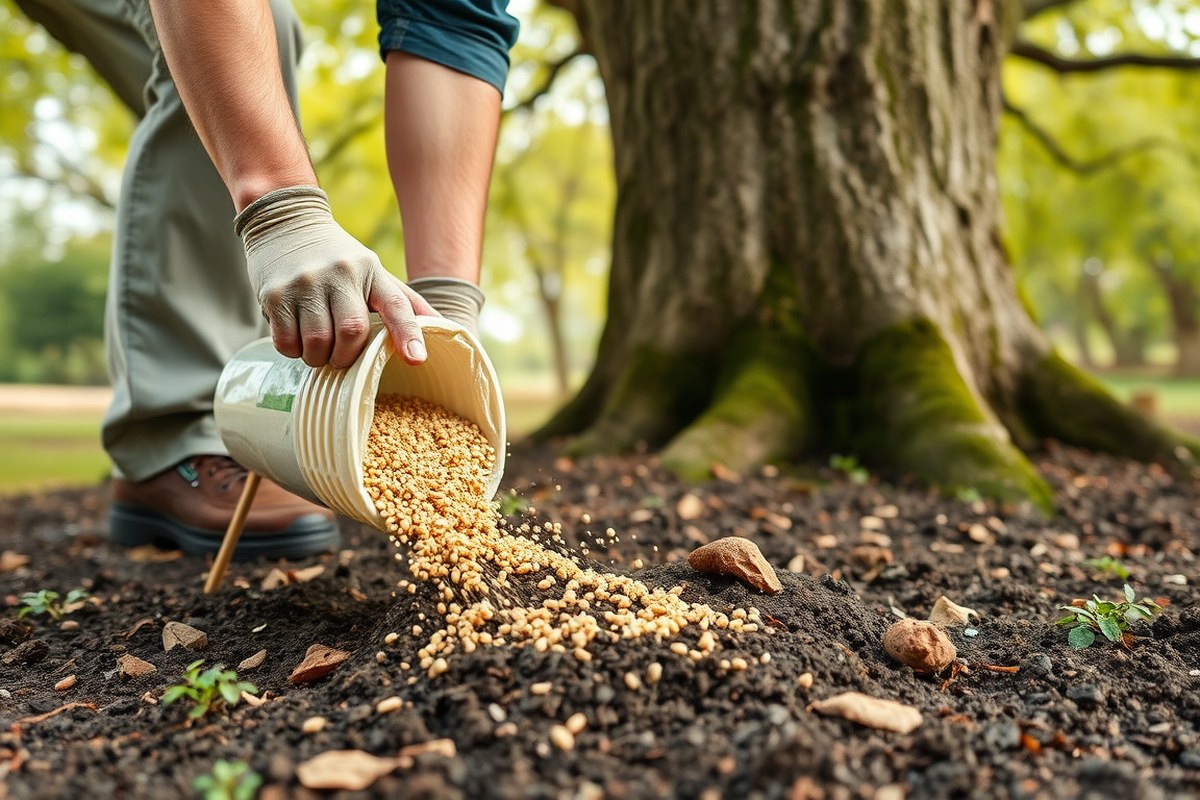
Spread slow-release granular fertilizer on bare soil or mulch. It’s an easy way to feed big trees. This helps trees get steady nutrition.
This method keeps feeding gradual, which mimics natural nutrient cycles. Applying fertilizer correctly with good timing takes care. But it saves money and time compared to fixing problems later.
2. How Often and How Much Fertilizer to Apply

You should base fertilizer amounts on your tree’s trunk diameter and how old it is. Mature trees need less frequent feeding, usually every 2 to 3 years.
Young trees benefit from yearly applications. Spread fertilizer widely, covering 1.5 times the branch spread to reach enough roots.
Calculating Fertilizer by Trunk Diameter
Measure your tree’s trunk diameter at about 4.5 feet from the ground. Multiply that diameter by a recommended fertilizer rate. University extension advice uses this as a simple, reliable way to avoid over- or under-applying fertilizer.
For example, if the trunk diameter is 10 inches, and you apply 0.1 pounds of nitrogen per inch, you would give 1 pound of nitrogen total. Never exceed 6 pounds of nitrogen per tree per application.
Applying Fertilizer by Tree Size
Young trees (less than 5 years old) need more nitrogen-based fertilizer to support growth. About 1 to 2 pounds of nitrogen fertilizer helps each spring.
Spread it around the tree’s root zone evenly. This feeds the tree well for new growth.
Established or mature trees are less needy. They only require feeding every 2 to 3 years unless soil tests show otherwise. Over-fertilizing mature trees can harm roots or cause excessive leaf growth instead of strong wood.
Needed Fertilizer Area and Coverage
Fertilizer should cover a wide root zone, not just near the trunk. Your tree’s roots typically spread 1.5 times wider than the branch canopy. For example, if branches reach 10 feet, spread fertilizer evenly in a 15-foot radius circle.
Spread granular fertilizer evenly in this area to ensure the roots take in nutrients thoroughly. Avoid piling fertilizer in spots or near the trunk to prevent root burn.
Step-by-Step Fertilizer Application Process
Use this simple method to apply the right amount and frequency of fertilizer. Follow these steps for best results and tree health:
- Measure your tree’s trunk diameter at 4.5 feet height.
- Calculate fertilizer nitrogen amount using 0.1 pounds per inch of diameter.
- Cap nitrogen at 6 pounds per application regardless of size.
- Measure the branch spread diameter and multiply by 1.5 for the fertilizer radius.
- Choose the right fertilizer type based on tree age and type.
- Spread fertilizer evenly in a wide circle around the tree covering calculated radius.
- Water the area lightly to help fertilizer soak into the soil.
- Repeat feeding young trees annually and mature trees every 2-3 years as needed.
Always avoid fertilizing when the ground is frozen or rain is expected. This helps prevent nutrient runoff and damage to your tree roots.
Adjustments for Special Situations
Your tree needs time to recover from stress before fertilizing. Root damage from digging can stress the tree. Wait until the tree looks healthy again.
Feeding too soon can hurt the roots further. In poor soil or drought conditions, you might need to fertilize yearly even for older trees.
For fruit trees, add annual foliar zinc sprays besides nitrogen fertilizer to maintain fruit production. Flowering trees benefit from lower fertilizer doses to avoid reducing flower buds.
3. How to Identify Trees That Need Fertilizing
Look for leaves that are pale or yellowing, especially if they stay smaller than usual. Poor growth or fewer new twigs means your tree might need feeding. New twigs grow less than 6 inches a year.
This often shows a nutrient problem. Thin or sparse leaf cover also signals nutrient trouble.
Don’t confuse these with insect damage. That has other signs like holes or sticky sap.
Check the tree’s bark and roots for cracks or exposed roots too. Bare ground around the tree indicates it may lack nutrients in the soil. Sometimes a tree looks fine but still needs a soil test.
This is true especially for fruit-bearing trees. Small nutrient imbalances can affect fruit quality. A soil test from a local extension office or arborist usually costs between $10 and $30.
- Pale, yellow, or small leaves
- Less than 6 inches of new twig growth yearly
- Thin canopy or fewer leaves
- Cracked bark or exposed roots
- Bare or weed-covered soil near the trunk
- Fruit with poor color or size
- Soil pH above 7.0 reducing nutrient uptake
Test your soil if you see these signs or slow recovery. This includes drought or pruning stress signs. Keeping soil healthy helps your tree grow better.
Trees in rich, natural soil usually do well without fertilizer. Call an arborist if your tree shows several symptoms, not just one. This is more important for large or mature trees.
They know how to help best. Arborists can identify nutrient needs and spot diseases early.
This saves you time fixing problems. It also saves money over the long run.
4. Differences in Fertilizing Young, Established, and Mature Trees
Young trees under five years old usually need fertilizer more often than mature trees. They are still growing rapidly and establishing roots.
Use a balanced fertilizer with moderate nitrogen to help them grow. But avoid overdoing it to prevent root burn or excessive leafy growth.
Seedlings and saplings benefit from smaller amounts of fertilizer applied during the growing season. For example, you might use about 0.1 to 0.2 pounds of actual nitrogen per 100 square feet every few months.
Always check soil moisture and avoid fertilizing dry soil. Watering properly after fertilizing helps the nutrients soak into the root zone.
Mature trees, generally over 10 years old, usually don’t need fertilizer yearly. They often get enough nutrients from the soil and surrounding environment. Fertilizing every three to five years is usually enough.
Fertilize only if soil or leaf tests show nutrient deficiencies. Overfertilizing old trees can cause weak growth or stress.
Trees planted in the ground near lawns that get regular fertilizer usually don’t need extra feeding. The lawn fertilizer helps cover their needs. However, container-grown trees rely entirely on the potting mix for nutrients.
So they need more regular feeding. Feed container trees every 4 to 6 weeks during the growing season using diluted fertilizer.
Always apply fertilizer beyond the drip line of the tree, where most fine roots spread. This area can be two to three times wider than the tree canopy. For young trees, use a smaller fertilizer radius of 2 to 3 feet.
This should be measured around the trunk. It helps the tree grow better. Mature trees need fertilizer spread farther out.
Sometimes apply it to the drip line’s edge or beyond. This covers more roots for feeding.
Slow-release or organic fertilizers work better for young or container trees. They reduce root burn risks. These options feed trees gently over time.
Mature trees in good soil benefit from deeper root feeding. Use liquid fertilizer injections or spread granules evenly.
Target the root zone for best results. This takes time and care but supports long-term health without excess growth.
5. Choosing the Right Fertilizer for Your Trees
Picking the right fertilizer for your trees depends on the species and their needs. Knowing the NPK ratio and fertilizer type helps you avoid harm and get the best growth. You can pick organic or synthetic fertilizers.
Choose granular, liquid, or spikes for applying them. Each method fits different tree needs and care styles.
Common Fertilizer Types Explained
Granular fertilizers look like small pellets. You spread these granules on the soil to feed trees. They often release nutrients slowly, feeding your trees for weeks or months.
Liquid fertilizers deliver nutrients quickly but might need repeating. Spikes release nutrients directly into the soil near roots over time.
Most gardeners use granular fertilizer for shade and ornamental trees. It’s easier to apply evenly and safer for long-term tree health. Liquid fertilizers act quickly.
Use them to help trees during a drought or fast growth. They provide a quick nutrient boost.
Be cautious not to overapply fast-release liquid fertilizer; it can burn tree roots.
Fertilizer spikes can save time but may not spread nutrients evenly, especially for larger trees. Fertilizer spikes work best for small trees or quick fixes.
They might cost more. Be careful when inserting spikes to avoid root damage.
Recommended NPK Ratios by Tree Type
Trees have varying nutrient needs. Shade and ornamental trees thrive with nitrogen-heavy ratios like 3-1-1 or 3-1-2. These usually come as 12-4-4, 12-4-8, 16-4-8, or 20-5-10 fertilizers.
Fruit trees need different ratios, often balancing potassium and phosphorus more carefully. Applying the wrong ratio can reduce fruit yield or cause poor growth.
All-purpose balanced fertilizers near 10-10-10 suit many situations but consider specific tree needs for best results. Slow-release options in pellet form usually perform better for long-term nutrition.
| Tree Type | Recommended N-P-K Ratio | Typical Fertilizer Examples |
|---|---|---|
| Shade and Ornamental Trees | 3-1-1 or 3-1-2 | 12-4-4, 12-4-8, 16-4-8, 20-5-10 |
| General All-Purpose | Balanced 10-10-10 | Slow-release granular pellets |
| Fruit Trees | Different ratios, often higher in phosphorus and potassium | Specific to fruit species |
Choosing the right ratio means reading the label carefully. Never guess doses, and watch for signs of deficiency or overfertilizing.
Organic vs. Synthetic Fertilizer Benefits
Organic fertilizers come from natural sources like compost or manure. They release nutrients slowly and improve soil health over time.
Synthetic fertilizers offer a precise nutrient mix and work fast. You can find slow-release synthetic pellets that supply nutrition steadily without polluting groundwater.
Organic options usually cost more upfront but build soil. Synthetics are cheaper and act fast. Avoid overusing fast-release fertilizers on sandy soil to prevent nutrient runoff.
6. Where and How to Apply Fertilizer Around Trees
Apply fertilizer in a ring around your tree, starting 2 feet from the trunk. Extend the feeding area out to at least the tree’s drip line, where the branches end. Spread it evenly to help roots take up nutrients safely and effectively.
Calculating the Fertilizing Area
Measure the area where roots grow to know how much fertilizer to use. This area usually runs from about 2 feet from the trunk to the drip line.
Parts of the root zone may overlap a path or driveway. Change fertilizer amounts based on that spot’s size.
Find the area by measuring from the trunk to the drip line. Then, use a simple formula to calculate it.
That helps to spread the right quantity without wasting fertilizer or harming plants. Newly planted trees may need less or no fertilizer until roots establish.
Safe Application Practices
Broadcast fertilizer evenly in a ring covering the root zone to avoid concentrated spots. Avoid piling fertilizer right next to the trunk to prevent burning the bark. Keep fertilizer off grass and away from any nearby waterways to protect them.
Grass around the tree often fights for water and nutrients. It can make feeding the tree harder. Put a barrier between the grass and tree roots.
Apply fertilizer only under the tree to help both. Cut back fertilizer amounts if walkways or other hard surfaces reduce the root area.
Watering After Fertilizing
Water the ground after applying fertilizer to help nutrients soak into the soil. This also protects roots from fertilizer burn and reduces runoff risk. Use about 1 inch of water, enough to moisten the area but not flood it.
For slow-release fertilizers, watering still helps nutrients start moving into the root zone. Newly planted trees need careful watering to promote root growth and better nutrient uptake. Avoid watering right before rain to prevent nutrients washing away.
- Measure the distance from the trunk to the drip line in feet.
- Calculate the root area to figure out the fertilizer amount needed.
- Clear away grass or mulch from the base, keeping a 2-foot distance from the trunk.
- Evenly scatter the fertilizer in a ring from 2 feet out to the drip line.
- Adjust quantities for obstacles like pavement that cover root areas.
- Avoid fertilizer contact with the trunk and nearby grass or plants.
- Water the fertilized area with about 1 inch of water afterward.
7. Common Mistakes and How to Avoid Them When Fertilizing
Putting fertilizer on frozen ground is a mistake that can harm the tree roots. Fertilizing too early wastes nutrients and can cause burns in the roots. Wait until soil temps rise and the ground is workable before adding fertilizer.
Applying too much fertilizer is another common error. Over-fertilizing leads to salt buildup in the soil, which pulls moisture away from roots.
Signs include browned leaf edges, wilting, or yellowing leaves. When this happens, water your tree deeply to flush extra fertilizer.
Choosing the wrong fertilizer type for your tree is a frequent problem. For example, a lack of magnesium or zinc causes yellowish leaves, known as chlorosis.
Use a fertilizer with these micronutrients to correct it. Always match fertilizer content to your soil and tree needs.
- Never fertilize when the ground is still frozen or snow-covered.
- Check the soil before applying; avoid adding more if nutrients are sufficient.
- Use fertilizer with added micronutrients if your tree shows chlorosis symptoms.
- Follow package instructions closely to avoid overfeeding and root damage.
- Water the tree after fertilizing to help nutrients soak into the soil.
- Do not fertilize late in the growing season to prevent weak growth.
- Test soil every few years to adjust fertilizer type and amount properly.
Some trees react poorly to incorrect timing or product choice. Too much nitrogen late in the season encourages tender growth that freezes.
Weak leaf and twig growth invites pests or disease. When unsure, get a soil test or ask a local extension office.
Over-fertilized trees can lose their vigor rather than gain it. Leaves may turn brown or drop early. Roots might shrivel, reducing water and nutrient uptake.
Keep an eye on your trees and adjust fertilizer amounts as needed. Walking the line between underfeeding and overfeeding is key for healthy growth.
8. Environmental and Safety Precautions When Fertilizing Trees
Avoid fertilizing trees right before heavy rain. Excess fertilizer can wash away, polluting nearby waterways. Fertilizer runoff harms fish and plants by causing excess algae growth.
Protect nearby lawns and water by applying fertilizer slowly and evenly. Stop applying if the ground is very wet or frozen. Keep fertilizer off sidewalks and driveways to stop it from washing into drains.
Wear gloves and long sleeves when handling fertilizer. Use a spreader to evenly distribute fertilizer around the tree’s drip line.
This tool helps control the amount and reduces waste. After application, water the soil lightly to help fertilizer soak in.
For trees smaller than 6 inches in diameter, use half the recommended nitrogen rate. Too much fertilizer can damage shallow roots, especially for evergreens. Check local rules about fertilizer use near waterways to avoid fines or restrictions.
Avoid fertilizing during heavy rain or right before it to prevent runoff.
Use organic or slow-release fertilizers to reduce the risk of pollution. These break down slowly and lower nutrient leaching.
Cost varies but can be more expensive upfront, often around $10-$20 per 5 pounds. The extra cost may save money by reducing the need to reapply.
Keep fertilizer bags sealed and store them in a dry place. Spills can harm grass and garden plants. Cleaning spills quickly with water limits damage and keeps the area safe for pets and children.
Step-by-Step Action Plan for Fertilizing Your Trees
Use this simple plan to feed your trees the right way. Follow each step and check how your tree responds.
- Early Spring: Apply fertilizer just before leaves sprout. Watch for new green growth within two weeks.
- Mid-Spring: Water the tree well after fertilizing. Soil moisture helps roots absorb nutrients better.
- Late Spring: Check tree leaves and overall color. Healthy leaves look vibrant, not yellow or pale.
- Summer (Optional): Use a light boost if growth slows or leaves yellow. Avoid over-fertilizing; watch for leaf burn.
- Fall: Avoid fertilizing late in the season. Trees prepare for dormancy and won’t use nutrients well.
- Every Year: Test the soil every 2-3 years. Adjust your fertilizer type and amount based on the results.
- After Fertilizing: Mulch around the base to keep moisture and nutrients in the root zone.
- Ongoing: Watch the tree’s health through the seasons. Adjust care if you see stress signs like drooping or spots.
Frequently Asked Questions
Can Fertilizing Trees in Winter Harm Them?
Fertilizing trees in winter can cause damage. Nutrients can stress trees during dormancy and lead to weak growth in spring. Wait until early spring or late fall for better results.
Is It Okay to Fertilize Trees Right After Planting?
Avoid fertilizing right after planting trees. New roots need time to settle and grow. Fertilize after the first growing season to support healthy development.
Can Too Much Fertilizer Cause Tree Roots to Burn?
Yes, excess fertilizer can burn tree roots. Over-fertilizing concentrates salts in the soil, damaging roots and reducing tree health. Use recommended amounts carefully to prevent injury.
How Soon After Fertilizing Will I See Tree Growth?
You may see growth improvement in a few weeks. Trees take time to absorb nutrients and produce new shoots. Results vary based on tree type and soil condition.
Should Trees Near Lawns Be Fertilized with the Same Fertilizer?
Not always; trees and lawns have different nutrient needs. Lawn fertilizers can harm tree roots if used excessively. Choose fertilizer specific for trees or a balanced option.
Does Fertilizing Help Trees Recover from Pest Damage?
Fertilizing can boost tree recovery but won’t fix pests directly. Nutrients strengthen tree defenses and healing. Use pest control alongside fertilizing for best results.
Wrapping Up
Fertilizing trees at the right time and place supports healthy growth. Start with early spring fertilizing to give trees a strong boost. Check your trees regularly to keep them thriving year-round.