How Much Mulch Needed: Complete Guide to Calculate and Buy Right Amount
Knowing how much mulch needed can save you time and money. Measure your garden bed’s length and width in feet first. Multiply those to get square feet, then decide mulch depth, usually 2 to 4 inches.
To convert this volume to cubic yards, you need math. Divide by 324 for 1-inch depth. Use 162 if the depth is 2 inches.
Remember, one cubic yard covers 324 square feet at just 1 inch thick. You usually want thicker layers, so smaller coverage per cubic yard applies.
Buy about 10 to 15 percent extra mulch to cover settling in the first few weeks. Mulch shrinks after placing, and you don’t want bare spots later. Pull mulch 2 to 3 inches away from stems or trunks to avoid rot and pests.
Key Takeaways
- Measure garden beds in feet to calculate square footage first.
- Choose mulch depth between 2 to 4 inches depending on purpose.
- Divide volume needed by 27 to convert cubic feet to cubic yards.
- One cubic yard covers 324 sq ft at 1-inch depth, less for thicker layers.
- Order 10-15% more mulch to allow for settling and shrinkage.
- Keep mulch edges 2, 3 inches from plant stems to prevent damage.
How to Calculate Mulch Needed for Any Garden Bed
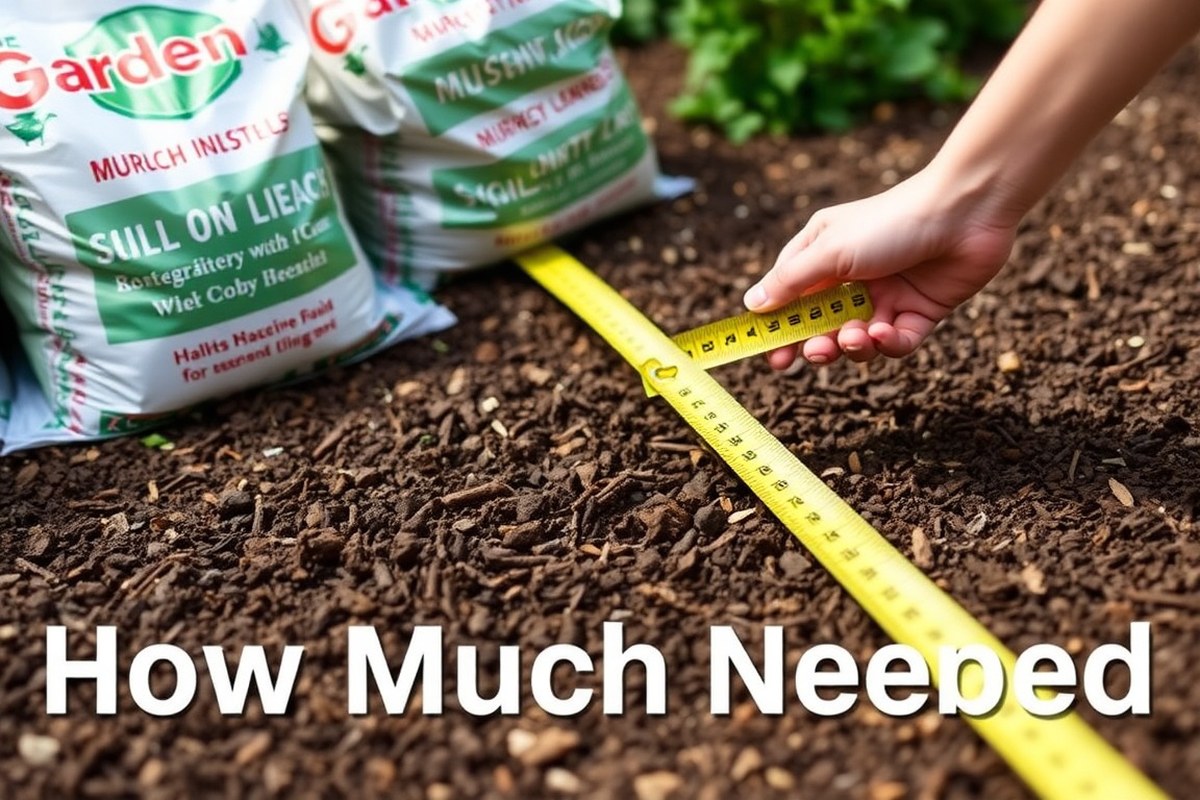
Knowing how much mulch you need means measuring your garden bed and using the right formula. Mulch volume depends on your bed’s area and the depth you want. Use feet for length and width, inches for depth, then convert to cubic feet or yards.
Here’s the straightforward way to calculate mulch volume and bags:
- Measure the length and width of your garden bed in feet.
- Multiply length × width to find the area in square feet.
- Decide on your mulch depth, usually 2 or 3 inches for flower beds.
- Convert your depth from inches to feet by dividing by 12. For example, 3 inches divided by 12 equals 0.25 feet. This helps match your units for calculations.25 ft).
- Multiply your area (sq ft) by depth (ft) to get mulch volume in cubic feet.
- Divide cubic feet by 27 to get cubic yards. For example, 27 cubic feet equals 1 cubic yard. Use this when buying mulch in yards.
- Find the number of bags by dividing cubic feet by bag size. Most bags hold about 2 cubic feet each. This tells you how many bags to buy.
For a 200-square-foot bed with a 3-inch depth, multiply 200 × 0.25 feet = 50 cubic feet. Dividing 50 by 27 gives about 1.85 cubic yards. For bags, divide 50 cubic feet by 2 cu ft per bag to get 25 bags.
| Unit Conversion | How to Convert |
|---|---|
| Square Feet to Cubic Yards | Area (sq ft) × Depth (in) ÷ 324 = Cubic Yards |
| Cubic Feet to Cubic Yards | Cubic Feet ÷ 27 = Cubic Yards |
| Cubic Feet to Bags | Cubic Feet ÷ Bag Size (cu ft) = Number of Bags |
Multiply your bed’s square feet by the mulch depth in inches. Then divide that result by 324. This quick formula finds the cubic yards needed.
It quickly shows cubic yards needed. One cubic yard of mulch covers 324 square feet at 1 inch deep.
At 2 inches deep, it covers 162 square feet. Use these numbers to plan coverage.
Many gardeners order a bit extra to allow settling and uneven coverage. Over-ordering by 10% helps keep your bed fully mulched. Avoid ordering too little; thin coverage can dry out plants and let weeds grow.
Recommended Mulch Depths by Plant Type and Purpose
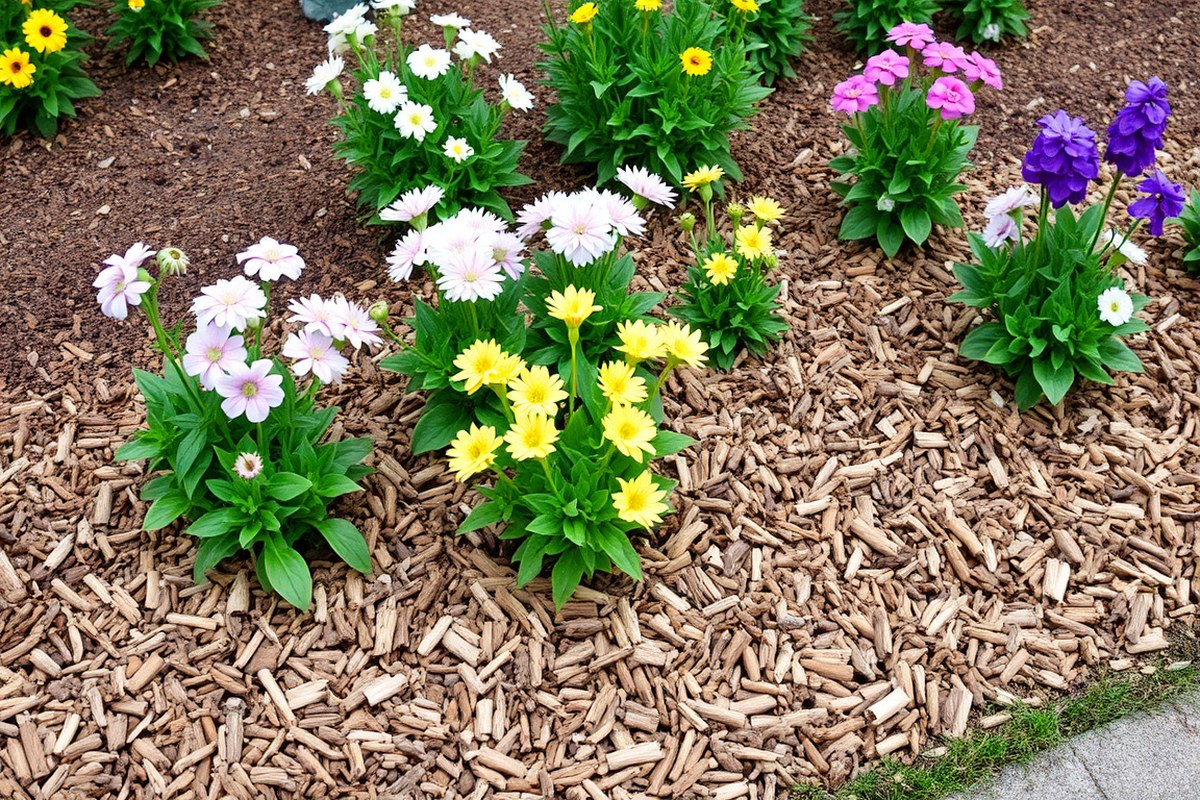
Use 2 to 3 inches of mulch for most garden beds. This helps keep moisture in and stops weeds. It works well in many garden spots.
Vegetable beds and tree rings need 3 to 4 inches of mulch. This extra depth protects roots. It also helps soil keep moisture better.
Mulch deeper than 4 inches can hurt plants. Too much traps moisture and cuts airflow. This can cause problems for plant health.
General Guidelines for Organic Mulches
Organic mulches like shredded hardwood usually need 2 to 3 inches deep. Bark nuggets and pine needles work the same way. Keep the depth even.
This range balances moisture retention and weed control without suffocating the soil. Leave 2 to 3 inches of space between mulch and stems.
This helps avoid stem rot. Air can circulate better around plants.
| Area | Depth | Notes |
|---|---|---|
| Flower/shrub beds | 2, 3 in | Keep mulch a few inches from stems |
| Vegetable beds | 2, 3 in | Use clean, weed-free mulch |
| Around trees | 2, 3 in | Make a wide mulch ring around tree trunks. Keep the mulch 3 to 6 inches away. This prevents damage to the bark. |
| Paths | 3, 4 in | Use chunky mulch so it stays put |
| Slopes | 3, 4 in | Choose fibrous/chunky mulch to resist wash-off |
| Containers | 1, 2 in | Helps soil hold water and stop splashes |
Organic mulch like shredded leaves adds nutrients but should be applied in thinner layers. Bark mulches last longer but may need annual topping up. Bulk mulch costs can vary from $15 to $50 per cubic yard depending on type.
Keep mulch 2 to 3 inches away from stems and tree trunks to prevent rot.
Depths for Vegetable and Tree Rings
Vegetable gardens grow better with 2 to 3 inches of organic mulch. It stops weeds from growing. It also keeps the soil moist.
Clean, weed-free mulch is critical here to avoid introducing seeds or pests. Mulch around trees should be 3 to 4 inches deep.
Keep it 3 to 6 inches away from the trunk. This prevents bark from getting damaged.
Tree rings benefit from slightly deeper mulch because it protects roots and conserves moisture longer. Extend the ring as the tree grows to cover a wider root zone. Avoid piling mulch against the trunk to reduce disease risks.
Use 3 to 4 inches of mulch for tree rings and vegetable beds. But keep mulch pulled away from stems.
Avoiding Mulch-Related Plant Damage
Too much mulch, especially over 4 inches, can trap moisture and reduce airflow. This causes root rot and invites pests and disease. Mulch piled against stems or trunks can suffocate bark and lead to dieback.
Keep mulch 2 to 3 inches away from plant stems. For tree trunks, leave 3 to 6 inches space. This protects plants and trees from harm.
Add mulch every year in thin layers of 1 to 2 inches. This refreshes the mulch without hurting soil life.
Avoid piling too much at once. This allows roots to breathe while keeping soil moist and weed-free.
Mulch deeper than 4 inches can suffocate roots and promote disease in shrubs and trees.
Choosing Between Bagged and Bulk Mulch: What You Need to Know
Bulk mulch usually costs less per cubic foot than bagged mulch. You get more volume for your money when buying bulk. Bags are easier for small projects but cost more per unit.
Volume and Weight Differences
Bag sizes vary, mostly 2 or 3 cubic feet. You’ll need 14 bags of 2 cu ft to make one cubic yard. Or use 9 bags of 3 cu ft for the same.
Both options cover about one cubic yard. Bulk mulch can vary in moisture, weighing 400 to 800 pounds per cubic yard.
Heavier mulch means denser material or more moisture. That affects how much covers your area and the effort to move it around your garden.
Cost per Cubic Foot and Yard Comparison
Bulk mulch typically runs $25 to $45 per cubic yard, averaging near $35. This means about $1.30 to $1.70 per cubic foot. Bagged mulch costs about $3.00 per cubic foot but varies.
Here’s a cost comparison for common mulch purchase options:
| Mulch Form | Volume per Unit | Units per Cubic Yard | Cost per Unit | Cost per Cubic Yard |
|---|---|---|---|---|
| Bulk Mulch | 1 cubic yard | 1 | $25 to $45 | $25 to $45 |
| Bagged Mulch (2 cu ft) | 2 cubic feet | 14 bags | About $6 (e.g., $5.99) | ~$84 |
| Bagged Mulch (3 cu ft) | 3 cubic feet | 9 bags | About $6 | ~$54 |
Bulk mulch is much cheaper if you need a cubic yard or more. Bags offer convenience but at a higher price per volume.
Recommendations Based on Garden Size
Use bags for small garden beds under 100 square feet. Bags make it easier to carry and spread mulch in tight spots. They come in ready portions that reduce overbuying.
Bulk mulch suits larger areas better than bags. For over 100 square feet, bulk saves money and time. You’ll need enough space to unload and store the bulk mulch.
Measuring Irregular Shaped Garden Beds for Mulch
Measure irregular garden beds by breaking them into smaller regular shapes. For circles, measure the radius, then calculate area as π times radius squared.
For triangles, multiply base by height and divide by two. Combining these with rectangles or squares covers most shapes.
Curved beds might need you to mark points along edges and use string to measure curves. Transfer these measurements to paper and sketch simple shapes inside. Add all these individual areas to get the total garden bed area.
Multiply the total area by your desired mulch depth to find volume. For example, a circular bed with radius 5 feet has an area of about 78.5 square feet (3.14 × 5²). Apply 3 inches (0.08 m) of mulch to get the best results.25 feet) of mulch, multiply 78.5 by 0.25 for about 19.6 cubic feet of mulch.
Volumes convert easily to cubic yards since mulch often sells that way. Divide cubic feet by 27 to get cubic yards.
So 19.6 cubic feet equals about 0.73 cubic yards. Measure each section this way, then add volumes for your total mulch need.
Measure the longest length of your bed. Measure its average width. Multiply these to find the approximate area.
This method works better for gently curved beds and helps avoid complex calculations. It’s less precise but saves time when exact accuracy isn’t critical.
Measuring carefully avoids buying too little or too much mulch. Too thin a layer leaves soil exposed, and too thick can suffocate plants. Mulch depths usually range from 2 to 3 inches.
Plant type matters. The texture of the mulch also changes the needed depth.
How Mulch Settling Affects Volume and How Much Extra to Order
Mulch naturally settles and compresses after you spread it. Expect a volume loss of 10 to 25 percent within the first few months. This shrinking happens because moisture, gravity, and microbes break down the mulch pieces.
You should buy about 10 to 15 percent more mulch than your calculated need. This extra amount covers settling and small losses from spillage or uneven ground.
Professionals usually add around 5 to 10 percent more. So staying near 10 percent gives you a safe buffer.
Timing your mulch topping is important to keep plants protected and soil healthy. Check mulch thickness yearly and add more when depth measures less than 2 inches. Most gardeners refresh mulch every 1 to 2 years, depending on weather and mulch type.
- Add 10% extra mulch to your total calculated volume for settling
- Order an extra bag or round up bulk mulch orders to nearest half-yard
- Inspect mulch depth in spring or fall to decide on topping up
- Plan for a 2 to 3 inch depth after settling for most garden beds
- Replenish mulch annually or every two years depending on composting speed
Always avoid piling mulch too thick at first. Start with more than desired depth to allow for settling.
For example, if your calculated volume is 8.5 cubic yards, multiply by 1.1 to get 9.35. Round up and order 9.5 cubic yards for a bulk delivery.
This step stops you from running out of mulch later. It also prevents having too much leftover mulch wasting space.
Also, remember that mulch type affects how fast it settles. Fine shredded mulch compresses quicker than larger bark pieces.
Keep an eye on your garden for mulch thinning signs. Add more mulch to keep soil moist and weeds down.
Common Mulch Calculation Mistakes and How to Avoid Them
Many common mulch calculation mistakes stem from mixing up depth units or ignoring bed shapes. Mulch depth needs converting from inches to feet for volume, use 2 inches as 0.166 feet. This keeps math clear and avoids underbuying.
Garden beds often have irregular shapes. Treat curved or angled beds like several rectangles or circles, then add those areas together. Overlooking this complexity leads to buying too little mulch.
- Confusing inches with feet when calculating volume
- Measuring only length and width, ignoring curves or islands
- Choosing mulch depth too shallow to prevent weeds
- Failing to account for mulch settling that reduces coverage
- Not ordering extra mulch for topping up after settling
- Buying too little mulch, causing extra trips and delays
- Buying too much mulch without a plan for surplus use
Fix depth conversion errors by multiplying area in square feet by depth in feet. For example, 200 sq ft at 2 inches: 200 × 0.166 = 33.2 cubic feet. Divide by 27 to get cubic yards, about 1.23 cubic yards here.
This matches the usual advice of 108 sq ft per cubic yard. It works for a 3-inch depth. Adjust the amount if your depth is different.
When you buy too little mulch, plan a quick follow-up purchase to avoid gaps. If you have too much, spread it to other garden spots. You can also use extra mulch to refresh your beds yearly.
Bulk mulch can store outdoors for months. But bagged mulch might degrade if kept too long.
Double-check measurements and conversions before buying. Order about 10% extra mulch to cover settling and future topping. These small steps save you time, money, and frustration during your gardening project.
How Mulch Type Influences Amount Needed and Coverage
Different mulch materials need varying thicknesses because of their density and how fast they break down. Organic mulches like wood chips usually require 2 to 4 inches. Inorganic types like gravel need only 1 to 2 inches.
Density and moisture affect how much each mulch covers. Denser mulch covers less area. Moisture content changes how often you must add more.
Organic Mulches Coverage and Depth
Organic mulches like bark, wood chips, and leaf compost break down. They settle and shrink in volume over time. That means you’ll need to add more.
Fresh wood chips may settle by 15, 20% during the first month. Shredded bark settles a bit less, around 10, 15%. Compost mulch can lose 20, 30% of its thickness.
These mulches work best spread to depths between 2 and 4 inches. Lighter mulches like straw are often applied around 3 inches. Wood chips sit comfortably at 2 to 3 inches.
Use 2 inches of mulch for decoration and less work. This depth usually looks good and controls weeds well.
| Mulch Type | Typical Depth | Settling Rate | Recommended Replenish |
|---|---|---|---|
| Wood Chips | 2, 4 inches | 15, 20% | Every 1, 3 years |
| Shredded Bark | 2, 4 inches | 10, 15% | Every 2 years |
| Leaf Compost | 2, 3 inches | 20, 30% | Annually |
| Straw | 3 inches | Varies | Seasonally |
Replenish organic mulch as it breaks down or gets compacted. Applying mulch in spring and fall helps maintain proper depth and protects plants across seasons.
Inorganic Mulches Coverage and Depth
Inorganic mulches like rubber, gravel, or decorative stone don’t decay. So they need less frequent replenishing. Rubber mulch usually needs 1.5 to 3 inches to work well.
Spread gravel and stone about 1 to 2 inches thick. This thickness stops weeds from growing. It also helps keep soil moist.
These mulches are denser and heavier per volume than organic types. Their coverage is less affected by settling but depends on particle size. Small gravel covers more evenly but may shift more than larger stones.
| Mulch Type | Typical Depth | Settling Rate | Recommended Replenish |
|---|---|---|---|
| Rubber Mulch | 1.5, 3 inches | Minimal | Very infrequent |
| Decorative Gravel | 1, 2 inches | Minimal | Rarely |
| Stone Mulch | 1, 2 inches | Minimal | Rarely |
Mulches that don’t break down need less frequent adding. Add more only if they move or soil builds up. Inorganic types tend to have a modern look and won’t add nutrients to your soil.
Effects of Mulch Density and Moisture
Mulch density affects how much volume you need. Dry wood chips take up more space but weigh less.
Damp mulch packs down and weighs more. Heavier mulch can be harder to spread evenly without extra help.
Moisture also changes coverage. Wet mulch sticks together and settles more quickly. In spring, mulch often contains more moisture from rain or irrigation, reducing the volume you’ll need.
Particle size and moisture together affect handling and coverage rates. Larger particles create more spaces and less density, offering better airflow but sometimes less consistent coverage. Smaller particles pack tightly but shrink faster as they dry.
Best Practices for Applying Mulch Correctly for Longevity
Keep mulch 6 inches away from tree trunks and plant stems to avoid rot. Avoid piling mulch directly against bark because trapped moisture invites decay. Spread mulch 2 to 4 inches thick after the first hard freeze.
Do it on a mild day to protect roots during winter. This layer helps keep soil temperature stable.
Check mulch depth regularly and thin it if it builds up, especially close to trunks. A thin layer of 1-2 inches suits fine mulch.
Coarser mulch needs 3-4 inches to work best. Mulch protects soil, controls weeds, and keeps roots cool but only when applied correctly.
- Wait until after the first hard freeze or a calm mild day
- Keep mulch 6 inches away from trunks and plant stems
- Apply 2-4 inches thick for most bark or woodchip mulch
- Don’t pile mulch into a “volcano” shape around trees
- Rake evenly and leave stems fully exposed
- Check and thin mulch if it builds up over time
Refresh mulch yearly, usually in late fall, to maintain benefits. Avoid adding thick layers right on top of plants you plan to transplant soon. Mulch can stop some tools from hurting bark.
Keep mulch from piling high against the trunk. High mulch can cause damage instead of protection.
Never push mulch against tree trunks, leave a 6-inch gap to prevent bark damage and rot.
Step-by-Step Action Plan for Mulching Your Garden
Follow these steps to measure, buy, and lay the right amount of mulch for your garden. This helps your plants stay healthy and your garden look neat.
- Before you buy: Measure your garden beds carefully using a tape measure or string. Confirm bed shape and size to avoid buying too much or too little mulch.
- Day 1: Decide the mulch depth based on the plants and use (usually 2-4 inches). Use more for weed control and less for delicate plants.
- Day 2: Pick a mulch type within your budget. Choose one that suits your garden style. Options include hardwood, bark, or cocoa mulch. Bulk is cheaper for big areas; bagged is good for small spots.
- Day 3: Calculate mulch volume using bed area and depth. Add 10-15% extra for settling and uneven ground.
- Day 4: Buy mulch from a reliable supplier. Check for clean, fresh mulch without mold or excessive wood chips.
- Day 5: Lay mulch evenly, keeping it 1-2 inches away from plant stems and tree trunks. This avoids rot and pest problems.
- After 4 weeks: Check mulch depth and replenish any spots that have settled too much. This keeps the coverage consistent and effective.
Frequently Asked Questions
How Much Mulch Do I Need for a 10 by 20 Ft Garden Bed at 3 Inches Deep?
You’ll need about 1.85 cubic yards of mulch. Multiply 200 square feet by 3 inches, then divide by 324 to get cubic yards. Add 10-15% extra for settling and coverage.
Can I Reuse Old Mulch or Do I Need to Add More?
You can refresh old mulch yearly or every few years. Thin or shredded mulch needs yearly replacement.
Thicker bark-style mulch can last 2-3 years. Always check for signs of decay or pests before reusing.
How Do I Adjust Mulch Amounts for Slopes or Uneven Beds?
Estimate the average depth and area of your slope first. Use those numbers to calculate volume. Add 10-15% extra mulch for uneven spots that need filling.
Should I Mulch Closer or Farther from Tree Trunks?
Keep mulch 3-4 inches away from tree trunks. This prevents moisture buildup and can stop rotting. For shrub woody stems, keep mulch 2-3 inches away.
Does Mulch Type Affect How Much I Buy?
Yes, coarse mulch covers less per cubic yard than fine shredded mulch. Calculate volume needed, then expect less coverage with bigger chunks. Bulk mulch pricing also varies.
How Do I Convert Cubic Feet of Mulch Needed into Bags?
Divide total cubic feet needed by bag size in cubic feet. Bags usually list volume on the label. Always round up to avoid running out mid-project.
Final Thoughts
Getting the right amount of mulch takes good measuring and picking the proper mulch type. Apply it with the right depth for your plants and check after a few weeks. Now, grab a tape measure and calculate your mulch area to get started today.